| There was no jetty at the other side so we scraped up on to the rocks. I can remember the smell of the seaweed which was covering the rocks (did I mention it was low tide). All the rocks at this level were green and slippery so we pushed off and moved a little further and found a better spot. Out we got and us two boys bounded up the ill defined path to the top of the river bank and then had to go back down to help Mum. We were right at the beginning of the pier which stretched out seemingly for ever in front of us. | 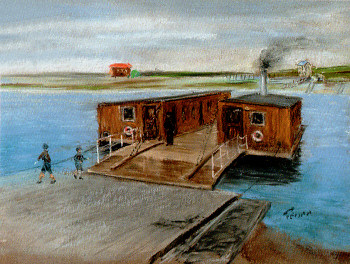 | flywheel with a couple of notches in it. Each time a notch got to the right place it triggered a large bellows which blew the horn. This was an important lighthouse so there was a backup fog horn the exact same standing next to the main one. Gramps then took us into the lighthouse up to the second floor where he showed us the backup for the backup fog horn. This was smaller and was turned by hand but he said he hoped the others never broke down because he couldn't keep that one going for long himself. | |
| It was actually about a mile long with a bend half way along. The people who built it in 1884 knew what they were doing because it was solid concrete up to about 15 feet from the walkway. The walkway was about 10 feet wide, wood with iron railings and was well above the water level which never got up to the top of the concrete portion even at high tide although in bad weather the waves did wash over it. About halfway along we realised that we were literally walking out into the North Sea. The wind was blowing spray from the rocks on the north side and Mum was hanging onto her hat and having trouble because her high heels kept slipping down a crack in the boards. The strange thing that I noticed was that there really was no wind in town that day but on the pier it seemed pretty strong. We found out later that my grandfather who rode his bike to work often had to leave the bike at the end of the pier and pull himself hand over hand along the railing to stop from being blown off in worse weather. Finally we were at the lighthouse and I ran up to the door and knocked. By the time the old folks had caught up there was still no answer and Mum said he wouldn't be able to hear us because that was an outer door. Sure enough when we opened the narrow door we found ourselves inside the wall of the lighthouse with another door about 4 feet away. | We then climbed a ladder up to the light itself and this is where I still marvel at the engineering and optical skills that were present in that room. The lenses themselves were glass and stood about 4 feet square looking very much like a huge bottle glass window. There were four of these mounted on a steel circular frame which must have weighed a ton. This whole thing fit into a circular channel where it literally floated in a mercury bath. Huge as it was it could be set moving with the very light touch of a finger. Inside the circle was the light source and I was expecting something spectacular because the light could be seen for miles and miles. There was electricity in the light house but it was a recent addition and only used to light the living quarters. The actual light used oil and was a mantle just like an ordinary gas mantle only instead of being about one inch diameter this one was maybe three or four inches. That tiny light would not have been visible for more than a hundred yards and then would have been just a spark but with the lenses to help it became a search light. After touring the lighthouse gramps sang sea shanties to us for a while (he could sing sea shanties for hours at a time and never repeat one and they were all very funny. This came from his days at sea on sailing ships which took months to get to China from England.) We then started back. The sun came out and I saw a sight few in Blyth have ever seen. There was a school of porpoises playing in the harbour. In war time they sometimes accompanied | ||
| Inside was a cosy circular room with a staircase and what looked like the lower half of a huge grandfather clock. This was the motor which turned the light and it did work just like a grandfather clock with weights on chains and a large pendulum. After tea and scones with my grandfather, he took us out to see the fog horn. It was in a sort of "lean-to"against the side of the lighthouse although again it was made of concrete. The fog horn was powered by a petrol engine which turned a huge |  | ships but no one I knew except gramps had ever seen them. From that day I never saw another porpoise in Blyth and I have never found anyone else who has seen them in N.E.England. I think Mum enjoyed the day but I don't know if the clothes she wore were a write off and I do know that she and grandma had a long talk with gramps about quitting the job before he was blown off that pier going to work. He did quit soon after that. GEOFF ANDERSON | |
| THIS ENGLAND'S ANNUAL 2016 17 |