 |
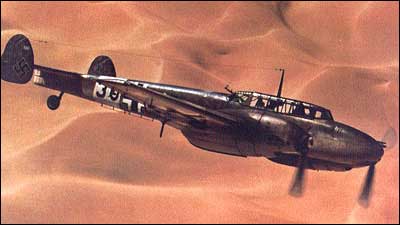
The Messerschmitt Bf110
|
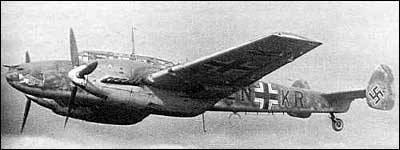
The Messerschmitt Bf110
was the backbone of the German Luftwaffe, when it came
to night fighting,
but it wasn't always held in such high regard by the
Germans.
 |
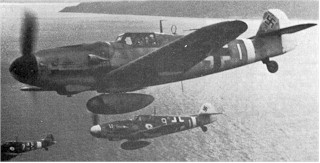 |
An example of the ME 109
Developed earlier
as a heavy day fighter to attack enemy bombers in 1934,
the twin engine aircraft failed miserably in that role
during the Battle of Britain.
Smaller, faster and more maneuverable aircraft like the
British single engine
Spitfire and Hurricane easily moved in from behind to
attack.
The Messerchmitt 110s "could not outrun them, or
out climb them," says Renald Fortier, curator of aviation
history at the National
Aviation Museum in Ottawa. "There was a gunner behind
the pilot [in the
Messerschmitt] with only one machine gun so when the
Spitfires attacked with
eight machine guns, they were in great trouble."
Still, the Messerschmitt 110 had heavy firepower, high
speed and long range.
As long as it avoided the single engine British fighters,
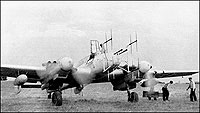
it was an effective fighter. After being fitted with radar (that looked
like deer antlers) on its nose,
the aircraft took to the skies at night, becoming the
first night fighter
of the Luftwaffe.
 |
Armed with two 20 millimeter cannons and five 7.9 millimeter
machine guns, the
aircraft attacked the British bombers from below in the
dark of night – thus
decreasing the risk of being detected. The Messerschmitt
110s became the
aerial mainstay of the German night fighting system called
Helle Nachtjagd or
"Illuminated Night fighting." They were later joined
by the Junkers Ju-88.
About 6,100 Messerschmitt Bf110s were built.
Specifications
|
Period:
Uses: Max Speed: Service Ceiling: Range: Power: Armament: |
World War II
Fighter Bomber 560 km/h (348 mph) 32,800 ft (9997.44 m) 695 mi (1118.46 km) Two Daimler Benz DB601A-1 engines Five 7.9mm machine guns |
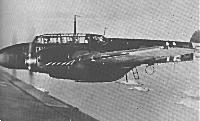 |
Messerschmitt Bf 110A-C
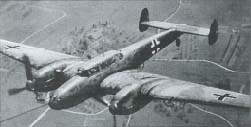 |
Two seater bomber
Approximately 6050 Bf 110s of all models.
1 Jan 1945 - The Allies are caught by surprise.
German fighter bombers strikes on airfields in Europe
(Operation Bodenplatte (Base plate)).
A total of 465 aircraft are destroyed on the ground,
but the
Luftwaffe loses 62 aircraft to Allied fighters and 172
to light AA (Anti Aircraft ground fire) including RAF Regiment gunners.
Whilst Allied losses are quickly
replaced, the Luftwaffe fighters arm is effectively destroyed.
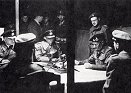 |
The German surrender

Designed by Pam Anderson/
All graphic designs
Copyright © 1999-2001 by P. Anderson
Information was gathered from
many sources and historical
archives, including my Father's
journal. Some images and information
from: The
Royal Air Force History Section
and also: Warriors of the
Night