
 |
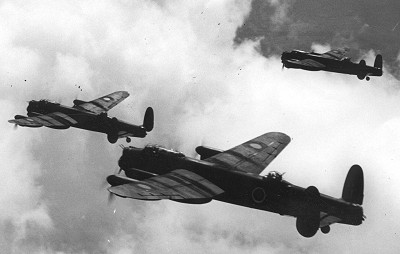
AVRO 683 "Lancaster"
Heavy bomber with 7 crew. Wingspan 31 m.
Power plant 4 Rolls Royce Merlin (1640 cu)
Weapons up to 6350 kg of bombs. Maximum
loaded weight 31,750 kg. Top speed 462 km/h
ceiling 7470 m. Range 4070 km.
 |
|
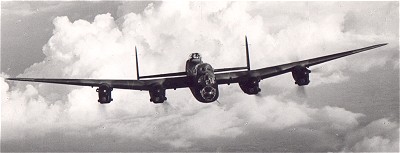
9 Jan 1941 - The Avro Manchester III makes its first flight equipped with four Rolls-Royce Merlin engines in place of the two Rolls-Royce Vultures used on earlier models. Ordered into production as the Lancaster, it becomes possibly the most famous RAF bomber of all time, after bearing the brunt of the Bomber Command offensive in Europe. 24 Feb. 1941 - Avro Manchester bombers make their operational debut in an attack against German naval targets in Brest harbor. 24 Dec 1941 - The Avro Lancaster enters service with No. 44 Sqn at RAF Waddington, Lincolnshire. It isn't until 3 March 1942 that the Lancaster makes its operational debut. April May 1942 - Bomber Command raids continue on Germany.
Larger numbers of aircraft (between 100 and 250) are now regularly dispatched
against a variety of industrial targets and
|
 |
|
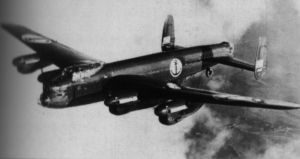
954 were damaged 6-7 Mar 1944 - Lancasters and Halifaxes of Bomber Command begin an offensive against the German transport network in occupied Europe, attacking railway yards in France. Eighty targets are selected, of which 37 are allocated to Bomber Command and the remainder to the AEAF (American Eighth Air Force.) 30-31 Mar 1944 - In a disastrous attack on Nuremberg,
Germany, Bomber Command suffers its heaviest losses of the entire war;
95 aircraft fail to return from 795 dispatched after being heavily
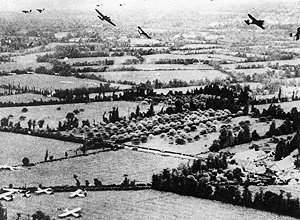
May 1944 - During the last two weeks of the month, Allied strategic and tactical air forces carry out attacks on enemy batteries and radar sites along the English Channel coast. By the first week of June, the strikes had destroyed about 80% of German coastal radar capability. 5 Jun 1944 - On the day preceding D-Day, Bomber
Command simulated an Allied air invasion by dropping dummy paratroops.
Lancasters and Stirlings also dropped Window at fixed intervals over
7 Jul. 1944 - Bomber Command aircraft are called in to bomb enemy positions the village of Caen after the Allied invasion had stalled; the first of five such attacks before mid August. 14 Oct 1944 - The highest number of sorties by Bomber Command aircraft in a single day, 1,576, are flown as part of Operation hurricane, a maximum effort attack on Germany. In two attacks on Duisberg, 9,000 tons of bombs are dropped and 14 aircraft lost. 4-5 Nov. 1944 - 174 Lancasters of No. 5 Group, RAF, breach the Dortmund EMS Canal, one of Germanys main transport arteries. |
 |
|
at 0842 hrs, and in the next ten minutes, twenty eight 12,000 lb Tallboy bombs were dropped before the ship capsized with the loss of 1,000 lives. |
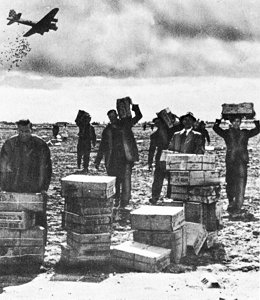 |
29 Apr 1945 - The start of Operation Manna.
Bomber Command aircraft
air drop 6,500 tons of
food and clothing
to Dutch people. The operation
continued until
8 May.
26 Apr 1945 - The first of some 75,000
ex-prisoners of
war are flown back to the UK by
aircraft of Bomber
Command.
8 May 1945 - VE Day. Germany surrenders
unconditionally,
and the war in Europe ends. The
Royal Observer Corps
is also stood-down from its
war footing and
assumes its peacetime role. At this
time there were
32,000 observers based at 1,420
posts around the
UK.
Click here for
The Messerschmitt 110

All page graphic designs
Copyright © 1999-2001 by /Camomile/P. Anderson